
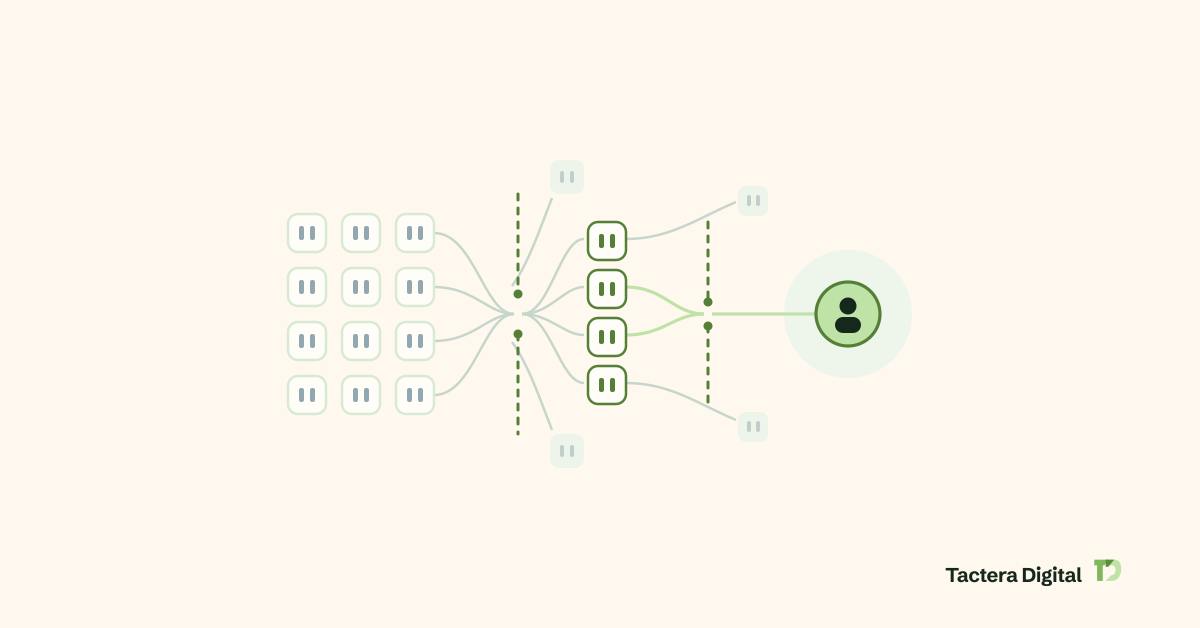
A B2B lead qualification framework ICP model has two layers that do different jobs. The fit layer scores account attributes against your Ideal Customer Profile. The readiness layer tests whether the buyer can act. Teams that run only the readiness layer fill pipeline with interested accounts that were never a fit, then lose them late. The weighting rules, disqualifiers, and framework choices below are where most models stay vague and where this one gets specific.
What Is a B2B Lead Qualification Framework Built on ICP?
Quick Answer: A B2B lead qualification framework built on ICP is a two-layer decision system. The first layer scores an account against fixed Ideal Customer Profile criteria to decide whether it is worth pursuing at all. The second layer applies a readiness framework such as BANT, MEDDIC, or CHAMP to decide whether the buyer can act now.
A B2B lead qualification framework built on ICP differs from a generic qualification checklist in one structural way: the fit decision is made before any conversation, using evidence that exists whether or not the prospect ever replies. Firmographic fit, technology environment, and observable trigger events are all knowable in advance. Budget, authority, and timing are not. Separating the two prevents the most common qualification failure, which is treating a responsive contact at a badly matched company as a qualified lead.
The framework has four working parts:
- A criteria set. Four to six weighted ICP attributes that predict whether an account can buy and succeed.
- A disqualification rule set. Hard conditions that remove an account regardless of how well it scores elsewhere.
- A fit score and tier. A number, and the action that number triggers.
- A readiness framework. The structured set of questions applied once a conversation starts.
Defining the Ideal Customer Profile itself is a separate exercise from building the framework that scores against it. This guide assumes you have a working ICP and shows you how to convert it into a scoring model, and Tactera Digital covers how to define a B2B ideal customer profile from scratch in a dedicated guide.
Why ICP Fit Belongs Before BANT, MEDDIC, or CHAMP
Quick Answer: ICP fit belongs first because readiness frameworks measure a moment and fit measures a structural match. A poorly matched account can pass BANT on a good day and still fail at procurement, security review, or renewal. Sequencing fit first also removes accounts before a seller spends discovery time on them.
ICP fit belongs before BANT, MEDDIC, or CHAMP because readiness answers are supplied by the buyer and fit answers are verifiable by you. That asymmetry matters more now than it did when these frameworks were written, because the modern buying process gives sellers far less access and far more people to satisfy. The research below explains why a single-contact readiness check is a weak filter on its own.
What the Buying Data Says About Fit-First Qualification
Table 1: Buying-process findings that shape qualification design
| Finding | Value | What it means for your framework |
|---|---|---|
| Buyer preference for rep-free purchasing | 75% of B2B buyers | Readiness answers arrive late and incomplete, so fit must be scored without them |
| Deals involving supplier digital tools plus a rep | 1.8x more likely to be high quality | Qualification should identify accounts worth a human motion, not just any responder |
| B2B purchases driven by organizational change | 99% | Change events are the most reliable readiness proxy you can observe externally |
| Internal stakeholders in a typical buying decision | 13 | Single-contact “Authority” checks understate the real committee |
| External influencers in a typical buying decision | 9 | Consensus risk is a qualification criterion, not a late-stage surprise |
| Cycles where procurement is a decision maker | 53% | Procurement friction belongs in fit criteria for regulated or large accounts |
Sources: Gartner B2B buying journey research for the first three rows; Forrester, The State Of Business Buying, 2026 for the last three.
Read the table as a design brief rather than a set of talking points. Two of the six findings say the same thing in different ways: the information a readiness framework depends on is held by a committee you cannot fully reach. That is the argument for scoring fit from external evidence first and treating readiness as a second gate applied in conversation. The 99% figure is the most directly usable one, because it tells you that a qualification model with no change-event criterion is missing the strongest observable predictor available.
Fit-first sequencing is also what makes disciplined LinkedIn prospecting possible at all. If the fit layer is not settled before outreach begins, every list is a guess and every reply feels like progress.
The Two Layers of an ICP Scoring Framework
An ICP scoring framework separates criteria by whether they can be verified before contact or only established during a conversation. That single split determines where each criterion belongs and how it is scored.
Table 2: Layer structure of the framework
| Layer | Question it answers | Example criteria | Scoreable before contact |
|---|---|---|---|
| Layer 1: Account fit | Should we pursue this account at all? | Firmographic band, technology environment, structural need, change event | Yes |
| Layer 2: Buyer readiness | Can this buyer act in a relevant window? | Budget reality, economic buyer access, decision process, urgency | No |
Layer 1: Account Fit Criteria
Layer 1 criteria describe the account, not the person or the moment. They fall into three groups.
Firmographic fit covers revenue band, headcount band, industry, geography, and business model. These criteria are cheap to verify and they carry most of the predictive weight in outbound, because they determine whether your solution is economically sensible for the buyer.
Technographic fit covers the systems the account already runs. Technographic criteria earn their place when your solution depends on, replaces, or integrates with a specific system. If it does not, technographic criteria add noise and should be dropped rather than weighted lightly.
Situational fit covers structural conditions that create the problem you solve: a recently expanded sales team, a new market entry, a compliance deadline, a leadership change in the function you sell to. Gartner’s finding that 99% of B2B purchases are driven by organizational change is what makes this group predictive rather than decorative.
Layer 2: Buyer Readiness Criteria
Layer 2 criteria describe the buying moment and cannot be scored from a database. Budget reality, access to the economic buyer, the shape of the decision process, and genuine urgency all require a conversation. This is where BANT, MEDDIC, and CHAMP operate, and where the framework choice in the next sections applies.
Observable buying and intent signals sit awkwardly between the two layers. Treat them as one situational criterion inside Layer 1 rather than a layer of their own, and see Tactera Digital’s separate guide to buyer intent signals for how to source and validate them.
How to Weight ICP Criteria in a Scoring Rubric
Weighting is the step where most scoring rubrics fail, because teams add criteria instead of ranking them. A rubric with twenty criteria produces scores that cluster in the middle and separate nothing.
Choosing Four to Six Criteria
Use four to six Layer 1 criteria. The reason is arithmetic rather than stylistic. With four criteria you can express meaningful weight differences in round numbers. Past six, each additional criterion takes weight away from the ones that actually predict outcomes, and the score compresses toward the average.
Select criteria by one test: does this attribute change whether the account can buy and succeed, or does it only describe the account? Employee count usually changes it. Company founding year usually does not.
Assigning Weights by Predictive Value
Weights should reflect how strongly each criterion separated your closed-won accounts from your closed-lost ones. The model below is a worked example for a B2B services seller with a mid-market ICP, not a benchmark to copy.
Table 3: Worked ICP fit rubric, 100 points
| Criterion | Weight | Scoring rule | Why weighted here |
|---|---|---|---|
| Revenue or headcount band | 30 | 30 in band, 15 adjacent band, 0 outside | Determines economic viability more than any other single attribute |
| Structural need present | 25 | 25 confirmed, 12 likely, 0 absent | An account outside the problem cannot be sold into at any price |
| Change event in last 90 days | 20 | 20 confirmed event, 10 event 90 to 180 days, 0 none | Strongest externally observable readiness proxy |
| Function and seniority reachable | 15 | 15 named buyer identified, 7 function present only, 0 neither | Determines whether outreach can reach a decision |
| Technology or process environment | 10 | 10 compatible, 5 neutral, 0 incompatible | Relevant only where the solution depends on it |
Total possible: 100 points. Weights are illustrative and must be recalibrated against your own closed-won data before use.
Three properties of this rubric matter more than the specific numbers. First, no single criterion can carry an account on its own, because the largest weight is 30. Second, partial credit exists for every criterion, so near-fit accounts are visible instead of binary-failed. Third, the two largest weights sit on criteria that are verifiable without the prospect’s cooperation.
Industry-specific criteria weightings differ substantially, and Tactera Digital treats those in separate guides for managed security providers, SaaS, healthcare, insurance, and manufacturing.
Setting Evidence Standards for Each Criterion
A score is only as good as the evidence behind it. Most rubrics fail silently because a rep records an assumption as a confirmed fact. Publish an evidence standard alongside every criterion.
Table 4: Evidence standards and how they affect scoring
| Evidence level | Definition | Scoring treatment |
|---|---|---|
| Verified | Stated in a primary source: the company’s own site, filings, job postings, or a named contact’s own words | Full points for that criterion |
| Inferred | Reasonably deduced from an adjacent fact, such as headcount implying revenue band | Half points, flagged for confirmation |
| Assumed | Believed but unsupported by any retrievable source | Zero points, and the criterion stays open |
The rule that follows from Table 4 is simple: an account cannot reach the top fit tier on inferred evidence alone. That single constraint prevents the most expensive category of qualification error, which is a confidently scored account built on guesswork.
Writing Disqualification Criteria That Override the Score
Disqualification criteria are binary conditions that remove an account regardless of its fit score. They exist because some conditions are not weaknesses to be weighed. They are reasons the deal cannot happen.
Table 5: Example disqualifier rule set
| Disqualifier | Trigger condition | Action |
|---|---|---|
| Out of serviceable geography | Operating region your delivery model cannot support | Remove from list, no outreach |
| Structural blocker | Regulatory, security, or procurement requirement you cannot meet | Remove, record reason |
| Existing conflict | Direct competitor of a current client, or an active partner conflict | Remove, escalate for review |
| Recent loss | Closed-lost in the last 6 months on price or capability grounds | Suppress, revisit at 12 months |
| No reachable function | The function that owns your problem does not exist in the account | Remove from list |
| Explicit opt-out | Contact or company has asked not to be contacted | Permanent suppression |
Write disqualifiers as conditions, not as judgments. “Under 50 employees” is a condition and can be checked by anyone. “Too small to care” is a judgment and will be applied inconsistently across a team. Every disqualifier should be auditable by a person who was not involved in the original decision.
Disqualification is not the same as negative scoring, where points are deducted for weak signals rather than the account being removed. Tactera Digital covers negative scoring rules separately.
Fit Tiers: Turning a Fit Score Into an Action
A fit score is useless until it maps to a decision. Tiers do that mapping.
Table 6: Fit tiers and the action each triggers
| Tier | Fit score | Meaning | Action |
|---|---|---|---|
| A | 80 to 100 | Strong structural match with a live change event | Full personalized outreach, senior effort, multi-stakeholder approach |
| B | 60 to 79 | Good match, weaker timing or one gap | Standard outreach, confirm the open criterion early |
| C | 40 to 59 | Partial match, usually one large criterion failing | Nurture only, re-score at 90 days |
| D | Below 40, or any disqualifier | Not a fit, or blocked | No outreach |
Tier bands are a starting configuration, not a law. If your Tier A volume is under roughly 5% of your addressable list, the rubric is too strict to build a working motion on. If Tier A exceeds roughly 30%, the criteria are not discriminating and the weights need revisiting.
Note the boundary of this section deliberately. Tiers govern which accounts get worked and how hard. Where to set the numeric line at which a scored lead is formally handed to sales is a different decision with different inputs, and Tactera Digital addresses B2B lead scoring thresholds and the sales handoff in a separate guide.
BANT, MEDDIC, and CHAMP Compared
BANT, MEDDIC, and CHAMP are readiness frameworks, which means each one is a structured set of things to establish in conversation. They are not interchangeable, and they were built to solve different problems.
BANT: Budget, Authority, Need, Timeframe
BANT originated at IBM, which still publishes BANT criteria templates as a mandatory part of partner opportunity registration. Its four elements are Budget, Authority, Need, and Timeframe, and its original purpose was triage: deciding whether a lead deserved another hour of a seller’s time.
BANT’s strength is speed. Its structural weakness is the “A”. Authority modelled as one person does not survive contact with the 13-stakeholder decisions Forrester now documents. Use BANT as a first-conversation filter, not as a deal-inspection tool.
MEDDIC: Six Data Points for Committee Deals
MEDDIC was created at Parametric Technology Corporation in 1996 by Dick Dunkel, working with Jack Napoli under John McMahon, as documented by MEDDICC. Its six elements are Metrics, Economic Buyer, Decision Criteria, Decision Process, Identify Pain, and Champion.
MEDDIC answers a different question from BANT. BANT asks whether a lead is worth pursuing. MEDDIC asks how much you actually know about a deal you are already in, and which piece is missing. That is why it fits multi-stakeholder deals and long cycles, and why it is heavy for a first conversation.
CHAMP: Challenges First, Money Later
CHAMP reorders BANT into Challenges, Authority, Money, and Prioritization. The reordering is the whole point. Leading with the challenge rather than the budget produces a consultative conversation, and Prioritization is a sharper test than Timeframe because it asks where your problem ranks against everything else competing for the same budget.
Table 7: Readiness framework comparison
| Framework | Elements | What it measures | Best fit | Main failure mode |
|---|---|---|---|---|
| BANT | Budget, Authority, Need, Timeframe | Whether a lead clears a minimum bar | Short cycles, smaller deals, first calls | Treats authority as one person |
| MEDDIC | Metrics, Economic Buyer, Decision Criteria, Decision Process, Identify Pain, Champion | How complete your knowledge of a live deal is | Committee deals, long cycles, forecast review | Too heavy for a first conversation, high data-entry burden |
| CHAMP | Challenges, Authority, Money, Prioritization | Whether the problem outranks competing priorities | Consultative selling, problem-led discovery | Money established late, so pricing surprises arrive late |
The comparison points to a stack rather than a choice. Most teams that run all three well use CHAMP or BANT in the first conversation and MEDDIC once a deal is live. Picking one framework and forcing it across every deal size is what produces the leakage the next section addresses.
Which Framework Fits Your Deal Size and Cycle Length?
Quick Answer: Match the framework to committee size and cycle length rather than to company preference. Short cycles with one or two decision makers need a four-element filter. Deals with five or more stakeholders and cycles beyond three months need MEDDIC’s decision-process and champion dimensions, because those are the elements that actually predict slippage.
Framework selection is a function of deal shape, and deal shape is mostly determined by two variables you already know: how many people must agree, and how long they take. The table below maps those variables to a recommendation.
Table 8: Framework selection by deal shape
| Deal shape | Typical cycle | Decision makers | Framework | Reason |
|---|---|---|---|---|
| Transactional | Under 30 days | 1 to 2 | BANT | Speed matters more than depth, and authority genuinely is one person |
| Consultative mid-market | 1 to 3 months | 2 to 5 | CHAMP, then BANT elements to confirm | Problem ranking is the real constraint, not budget existence |
| Complex mid-market | 3 to 6 months | 5 to 8 | CHAMP for discovery, MEDDIC for the deal | Decision process becomes the largest slip risk |
| Enterprise | 6 months or more | 8 or more | MEDDIC or MEDDPICC | Paper process and competition need their own dimensions |
Use the table as a default, then check it against your own loss reasons. If deals are lost late to procurement or legal, you need MEDDIC-class dimensions one band earlier than the table suggests. If deals are lost early to non-response, the problem is in Layer 1 fit scoring, not in framework choice.
Combining Fit and Readiness Into One Qualification Matrix
The two layers become one framework when fit score and readiness score are plotted against each other. Each combination has a different correct action, and naming those actions is what stops teams from treating all four the same way.
Table 9: Fit and readiness qualification matrix
| Tier | High readiness | Low readiness |
|---|---|---|
| High fit (Tier A or B) | Work now. Full effort, multi-stakeholder, senior involvement. | Stay present. Long-cycle nurture on the account, not the contact. This is where most future revenue sits. |
| Low fit (Tier C or D) | Handle carefully. Interest is real but the account is not a match. Disqualify explicitly or scope down. | Disqualify. Record the reason and remove from the working list. |
The bottom-left cell is the one that damages pipeline, because it feels like success. A responsive contact at a poorly matched account produces meetings, forecast entries, and eventually a late loss. Writing the action down as “disqualify explicitly” gives a rep permission to end the conversation.
The B2B Lead Qualification Framework ICP Checklist
Use this checklist to confirm your framework is complete before it goes live.
- Four to six Layer 1 criteria are named, and each one changes whether an account can buy.
- Weights sum to 100, and no single criterion exceeds 30.
- Every criterion has a written scoring rule with partial credit defined.
- Every criterion has a published evidence standard.
- Disqualifiers are written as auditable conditions, not judgments.
- Fit tiers map to specific actions, not to labels.
- A readiness framework is assigned to each deal shape you sell into.
- The matrix action for high fit and low readiness is written down.
- A recalibration date is set.
Applying this framework to one specific account, criterion by criterion, is a related but separate exercise, and Tactera Digital covers analyzing a lead against an ICP qualification matrix in its own guide.
How to Qualify Outbound Leads Before Any Conversation
Outbound qualification has a constraint that inbound does not: there is no behavioural data, no form fill, and no expressed interest. Every readiness criterion is unavailable until someone replies. This is why an ICP-based framework matters more in outbound than anywhere else.
In practice this means three adjustments to the model above.
Layer 1 carries the entire decision. Whether an account is worked is decided on fit alone. The rubric is not a supporting input, it is the only input, so evidence standards must be enforced rather than encouraged.
Change events replace expressed intent. With no behavioural signal available, the change-event criterion becomes the closest available substitute. A funding round, a leadership hire into the function you sell to, or a stated expansion plan are the outbound equivalents of a pricing-page visit.
Readiness is established in the conversation, not before the meeting. The correct outbound sequence is to qualify fit before outreach, book the meeting on the strength of a relevant problem, then run the readiness framework in the meeting. Attempting BANT questions inside a first message is what produces the interrogation pattern buyers ignore.
This sequencing is also what separates a targeted motion from volume sending. Effective B2B LinkedIn lead generation depends on the fit layer being decided before a single message goes out, and the LinkedIn outreach messaging that follows only works when the list underneath it already passed the rubric.
How Do You Know the Framework Is Working?
Quick Answer: A qualification framework is working when Tier A accounts convert at a materially higher rate than Tier B and Tier C, and when your closed-won accounts score above your closed-lost ones. If those two patterns are absent, the criteria are describing your customers rather than predicting them.
Validation is a measurement exercise, and it needs a sample rather than an impression. The checks below can all be run in a spreadsheet, which matters because most teams building a first framework have no scoring tool.
Table 10: Calibration checks and what each one tells you
| Check | Method | Signal that something is wrong | Fix |
|---|---|---|---|
| Backtest | Score your last 12 months of closed-won and closed-lost accounts using the current rubric | Won and lost accounts score within a few points of each other | Replace low-separation criteria |
| Tier separation | Compare meeting-to-opportunity conversion by tier | Tier A and Tier C convert similarly | Reweight, do not add criteria |
| Tier A volume | Tier A as a share of the addressable list | Under about 5% or over about 30% | Adjust band boundaries first, weights second |
| Evidence audit | Sample 20 scored accounts and check evidence level per criterion | More than a quarter of criteria scored on assumed evidence | Enforce the evidence standard before changing the model |
| Disqualifier review | Review disqualified accounts quarterly | Accounts disqualified in error, or repeat losses that no disqualifier caught | Add or remove a condition |
Run the backtest on a minimum of 20 closed-won and 20 closed-lost accounts. Below that, differences between tiers are noise. Recalibrate on a fixed schedule of two reviews per year, plus one whenever your pricing, delivery model, or serviceable geography changes, because each of those changes the definition of a viable account.
Five Mistakes That Break an ICP-Based Qualification Framework
The failure patterns below account for most broken frameworks, and each one has a specific correction.
- Adding criteria instead of reweighting. When scores stop separating accounts, teams add attributes. This compresses the range further. The fix is to remove the criteria that showed no separation in the backtest.
- Scoring on assumed evidence. A rubric applied to guesses produces confident numbers with no predictive value. The evidence standard in Table 4 exists for this reason.
- Treating readiness answers as fit answers. A contact saying the timing is good does not make a badly matched account a fit. The two layers must stay separate in the record.
- Leaving disqualifiers unwritten. When disqualification lives in a rep’s judgment, it is applied inconsistently and cannot be audited or improved.
- Never recalibrating. An ICP built on last year’s won deals drifts as pricing, positioning, and delivery capacity change. A framework with no review date silently stops matching the business.
A sixth pattern deserves separate mention because it is often mistaken for efficiency. Applying the framework mechanically at volume, with no human check on whether the score reflects reality, reproduces the same problem tooling was supposed to solve. Tactera Digital’s guide to what LinkedIn automation can and cannot do covers where that line sits.
How Tactera Digital Applies ICP-Based Qualification
Tactera Digital runs the fit layer before any outreach begins, which is the operating principle behind every campaign we build, around one constraint: a meeting is only worth booking if the account would have passed the rubric without the conversation.
That shows up in three ways. Lists are built to a scored ICP rather than assembled by volume filters. Messages and follow-up are written by people rather than generated, because a fit-scored list is too small to waste on templates. The deliverable is a marketing-qualified meeting on an SDR or founder calendar, not a lead record.
Across client programmes, the same approach has produced 4,000+ qualified meetings booked, $40M+ in pipeline, and $4.5M+ in closed revenue. Both engagement models are built on the same qualification discipline: Managed Outreach runs the motion for you monthly, and Team Training and Handoff builds it inside your team once, and then hands it over so you run it in-house. You can compare the two Managed Outreach and Team Training and Handoff packages directly.
Conclusion
A B2B lead qualification framework icp model earns its place by making one decision explicit: whether an account is worth a conversation before that conversation happens. Get the fit layer right and the readiness framework you choose matters far less than the debate over BANT and MEDDIC suggests. Get it wrong and no framework will save the pipeline that follows. Start with four to six weighted criteria, publish your evidence standards, write your disqualifiers as conditions, and set a recalibration date before you go live.
If you would rather see the model applied to your market than build it from scratch, Book a Pipeline Fit Call. Bryan will score a sample of your target accounts against a working rubric and show you what your Tier A list actually looks like.
Frequently Asked Questions
What is ICP lead qualification?
ICP lead qualification is the practice of scoring an account against fixed Ideal Customer Profile criteria before assessing buyer readiness. It answers whether an account is structurally worth pursuing, using evidence such as revenue band, industry, and observable change events. It runs before any conversation and does not depend on the prospect’s cooperation.
What is a lead qualification framework?
A lead qualification framework is a repeatable set of criteria used to decide which leads deserve sales effort. Fit frameworks score the account. Readiness frameworks such as BANT, MEDDIC, and CHAMP score the buying moment through structured questions. A complete framework uses both, because an account can be a strong fit and still be unable to act.
What is the difference between lead generation and lead qualification?
Lead generation creates contact with potential buyers. Lead qualification decides which of those contacts deserve continued effort. Generation is a volume activity measured in leads created. Qualification is a filtering activity measured in wasted effort avoided. Running generation without a qualification framework produces high activity numbers and low conversion rates.
Is BANT outdated?
BANT is not outdated, but it is narrower than it once was. Its weakness is the Authority element, which models one decision maker while Forrester now records 13 internal stakeholders in a typical buying decision. BANT still works well as a fast filter on short-cycle deals. It is a weak tool for inspecting complex committee deals.
Is MEDDIC better than BANT?
MEDDIC is not better in general, it is better at a different job. BANT decides whether a lead is worth pursuing in a few minutes. MEDDIC assesses how complete your knowledge of a live deal is across six dimensions, which takes far longer. On a short transactional cycle MEDDIC is expensive overhead rather than an upgrade.
What is MEDDPICC compared with MEDDIC?
MEDDPICC extends MEDDIC with two additional dimensions: Paper Process, covering procurement and legal steps, and Competition. Those additions matter where contracts pass through procurement or security review, which Forrester found happens in a majority of buying cycles. On simpler deals the extra dimensions add administrative load without improving decisions.
How many criteria should an ICP scoring model have?
Four to six weighted criteria. Fewer than four makes the score too coarse to separate accounts. More than six dilutes the weights until scores cluster near the average and stop distinguishing anything. Selection matters more than count: keep only attributes that change whether an account can buy and succeed.
Can you run a qualification framework without a CRM or scoring tool?
Yes. A weighted rubric, a disqualifier list, and tier bands all work in a spreadsheet, and running it manually first is usually better. Manual scoring forces you to confront weak evidence and unclear criteria, which tooling hides. Automate only after a backtest shows the model separates won accounts from lost ones.
What is the difference between an MQL and an SQL in this framework?
An MQL has met a marketing-defined interest threshold. An SQL has been accepted by sales as worth working. In a fit-first framework both labels sit downstream of the fit score, because an account can generate MQL behaviour while failing the rubric entirely. Tactera Digital covers handoff definitions separately.
How often should you recalibrate an ICP-based qualification framework?
Twice a year as a baseline, plus an immediate review whenever pricing, delivery model, or serviceable geography changes. Each of those changes what counts as a viable account. Recalibration means backtesting the rubric against recent closed-won and closed-lost accounts, then reweighting. It does not mean adding criteria.
What if we do not have a clear ICP yet?
Build a provisional rubric from your last 10 to 20 closed-won accounts and look for attributes they share that your losses do not. Two or three criteria are enough to start scoring. Treat the first version as a hypothesis, backtest it after a quarter of outreach, and tighten it before adding new criteria.