
Key Takeaways
- Signal-based selling uses observable events to decide which companies to contact first and when. Fit still decides who qualifies.
- The method runs as a 6-step loop: define fit, choose signals, detect and verify, prioritize, reach the buying group, measure and prune.
- Tactera Digital makes first contact within 24 hours of verifying a trigger and reaches 3 to 5 people in each buying group.
- Run well, signal-based selling shortens the list: screening on our own market in October 2026 narrowed 376 companies to 26.
Signal based selling turns a static prospect list into a queue that changes every day. Companies that fit your market move to the top when something observable happens inside them: a new executive, a funding round, a hiring surge or a plant expansion. The change gives the company a reason to talk now, and it gives your team a reason to call that is about the buyer, not about you.
This guide explains what signal-based selling is, how it differs from list-based prospecting, how the work runs step by step, who owns each step, what RevOps has to set up, and why some teams find it turns into the same high-volume outreach it was meant to replace.
What Is Signal-Based Selling?
Signal-based selling is a sales approach that prioritizes companies and times outreach around observable buying signals: dated, public or first-party events that suggest a company has a new reason to buy. Instead of working a static list from top to bottom, the team works the companies with a live reason to act first.
Quick Answer: Signal-based selling is a B2B sales method that uses observable events, such as leadership changes, funding rounds, hiring surges and expansions, to decide which companies to contact first and when. It keeps fit as the qualification test and uses signals only to set outreach order, timing and the reason for the first message.
Signal-based selling rests on 2 defined terms. An in-market company is a company already showing signs it is looking to buy what you sell. A buying window is the period when an in-market company is actively evaluating and able to buy. Signals are the evidence used to spot in-market companies and estimate when their window opens. The types of buying signals and 25 examples are covered in the main guide to B2B buying signals.
The 3 Parts of Signal-Based Selling
Every signal-based selling program has 3 parts, and each part has its own job:
- Targeting. The market definition: industries, company sizes, regions and the problem your offer solves. Targeting decides who can ever become a customer.
- Timing. The observable event that moves a company up the queue this week. Timing decides who hears from you first.
- Relevance. The link between the event and your offer, carried into the first message and into the choice of people to contact. Relevance decides whether the buyer replies.
A program that is strong on timing but weak on targeting produces a busy calendar of companies that were never going to buy.
Signal-Based Selling vs Traditional Prospecting
Signal-based selling differs from traditional prospecting in what decides the order of outreach. Traditional prospecting works a list built once from firmographic filters and contacts everyone on it in a fixed cadence. Signal-based selling keeps the same fit filters but reorders the list every day around events that change who is likely to buy.
| Dimension | Traditional Prospecting | Signal-Based Selling |
|---|---|---|
| What builds the list | Firmographic filters, run once | The same fit filters, refreshed continuously |
| What decides the order | List order, territory or alphabet | Signal strength and signal age |
| When outreach starts | When the rep reaches the name | Within days of a verified event |
| Reason for the first message | A generic value statement | The specific change at that company |
| Who gets contacted | Usually one senior title | The buying group affected by the event |
| What gets measured | Activity: sends, calls, opens | Signals that turned into qualified sales calls |
| Main failure mode | Low relevance at high volume | Too many unverified alerts |
Neither approach removes the need for a good offer or a good list. Signal-based selling changes timing and relevance. It does not make an unqualified company qualified.
Why Signal-Based Selling Matters for Qualified Sales Pipeline
Signal-based selling matters for qualified sales pipeline because most companies in any market are not buying at a given moment, and the ones that are decide early. A team that reaches a company during its buying window joins the evaluation before a shortlist exists. A team that reaches the same company a quarter later usually finds the decision already made.
3 research findings make the case:
- Most of a market is out of market. The LinkedIn B2B Institute’s 95-5 rule holds that 95% of potential B2B buyers are not ready to buy today. A list worked in order spends most of its effort on that 95%.
- Buyers move before sellers arrive. The 6sense 2026 B2B Buyer Experience Report reports that 82% of first vendor contacts came from the buyer’s side, and that buyers’ first live conversation with a seller came after the midpoint of their journey.
- Irrelevant outreach is punished. A Gartner survey of 632 B2B buyers, published in June 2025, found that 73% of B2B buyers actively avoid suppliers who send irrelevant outreach.
For a team that needs more qualified sales pipeline, the conclusion is practical. More outreach to the same static list raises the share of irrelevant messages. Better timing raises the share of conversations with companies that have a current reason to talk.
How Signal-Based Selling Works
Signal-based selling works as a repeating loop of 6 steps: define fit, choose the signals, detect and verify, prioritize, reach the buying group, and measure. The loop runs daily or weekly, not once per campaign.
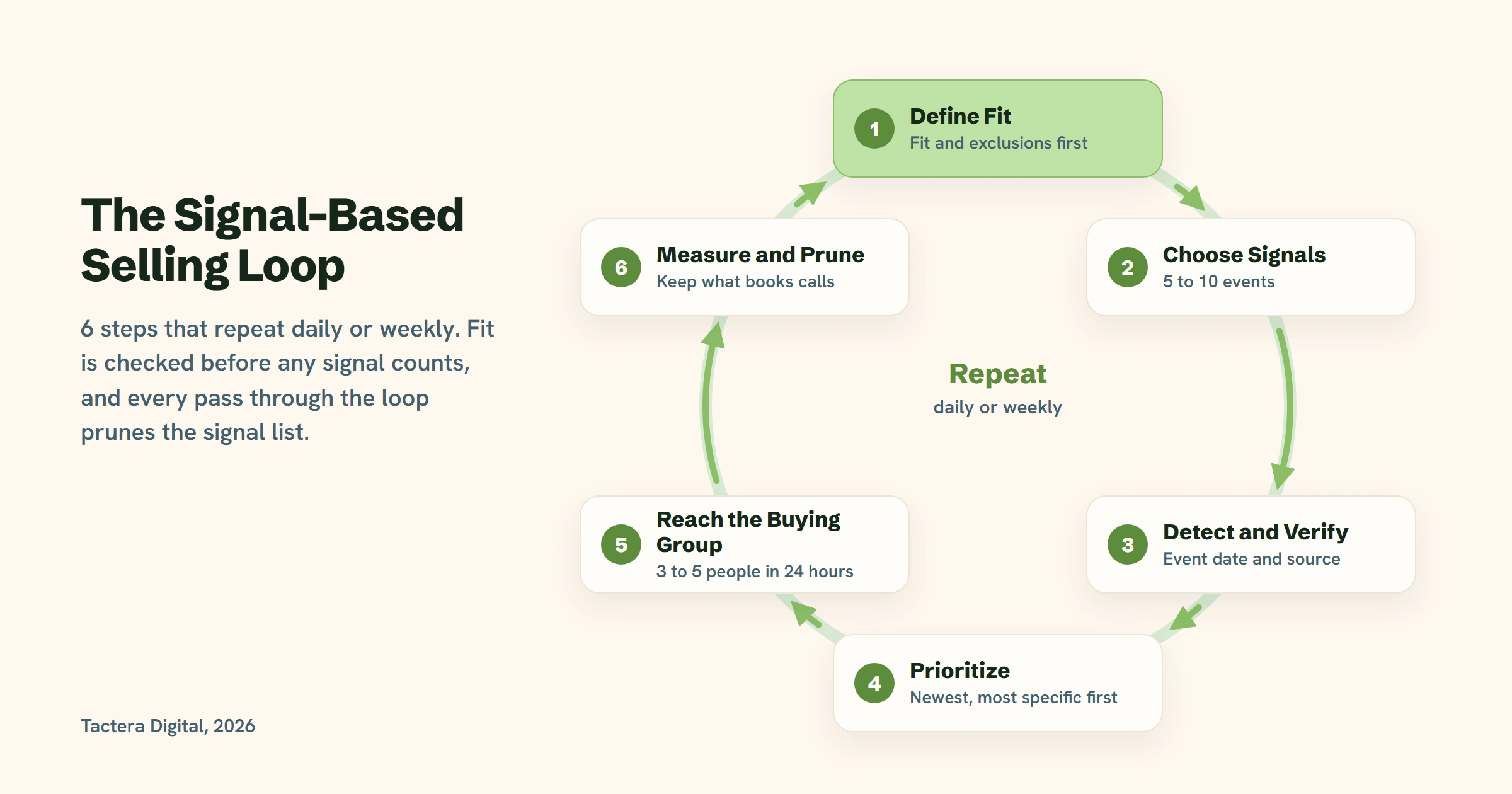
Step 1: Define Fit Before Any Signal
Fit is the qualification test, and it comes first. Write down the industries, company sizes, regions and problems your offer serves, plus the exclusions: current customers, open deals, competitors and companies contacted recently. Every signal is checked against this list before anyone acts on it.
Step 2: Choose Signals That Came Before Past Purchases
Choose 5 to 10 signals, not 50. Look at your best customers and ask which events happened at those companies in the months before they bought: a new leader in the buying role, new funding, a hiring push, a move, a compliance deadline. Those trigger events are the first candidates. Signals that matter vary by industry, so a list copied from another market rarely works without changes. In our own campaigns, the signals that have converted to booked sales calls fastest are a company starting to build an SDR team and, for cybersecurity professional services firms, a newly disclosed security breach in the prospect’s sector.
Step 3: Detect and Verify Each Signal
Detection means watching the sources where your chosen events appear. Verification means confirming the event happened, at this company, recently enough to matter. Record 2 dates for every signal: the event date and the detection date. A funding round detected this week may have closed months ago, and the event date is the one that decides relevance. The full verification checklist is in the guide to identifying and verifying buying signals.
Step 4: Prioritize by Signal Age
Prioritizing means ordering verified companies so the most recent, most specific events are worked first, because signal decay lowers the value of every signal as its buying window closes. The age bands I use, and the channels each band gets, are set out in the section on how long buying signals stay useful.
Step 5: Reach the Buying Group Within Days
Reaching the buying group means contacting the several people a company-level event affects, not only the most senior title. The buying group is the people who decide a purchase together: budget holder, decision-maker, project lead and day-to-day user. Mapping the B2B buying committee shows who those people are in most companies.
Outreach timing is part of this step. My team makes first contact within 24 hours of verifying a trigger, so the outreach lands while the change is still news inside the company.
The first message should make the connection between the event and your offer clear without reciting what you know about the company. Wording that feels relevant rather than intrusive is its own skill, covered in the guide on how to respond to buying signals.
Step 6: Measure and Prune the Signal List
Measuring closes the loop: each signal type earns its place by producing qualified sales calls, and the ones that do not are removed. Without pruning, the signal list keeps growing until the team is once again contacting nearly every company in the market.
Who Owns Each Step
Each step of signal-based selling needs one named owner. A signal that is detected by one team and acted on by another waits in between unless someone is responsible for moving it.
| Step | Typical Owner | Output |
|---|---|---|
| Define fit | Sales leader with RevOps | Written fit criteria and exclusions |
| Choose signals | Sales leader with the best closers | 5 to 10 signals with a reason for each |
| Detect and verify | RevOps or a research function | Verified signals with event date, detection date and source |
| Prioritize | RevOps rules, reviewed by the sales leader | A daily ordered queue |
| Reach the buying group | SDRs or sales reps | First touches within the agreed time |
| Measure and prune | RevOps with the sales leader | Monthly signal report and changes |
Tactera Digital takes on the whole loop for clients who would rather not staff it. Tactera Digital owns fit, signal monitoring through its Commercial Intent Monitor, verification, prioritization and outreach to the buying group, and books qualified sales calls directly into the client’s calendar; the client runs the sales conversation and the close. Across client programs, Tactera Digital has generated $110M+ in sales pipeline for clients in 2 years, $50M+ in closed revenue for clients in 2 years and 4,000+ commercial opportunities in 2 years, with the pipeline and revenue figures reported by clients.
Signal-Based Selling for B2B Prospecting
Signal-based selling in B2B prospecting works at the company level first, because B2B purchases are group decisions made over months. A company event such as a new chief operating officer or a new site affects the whole buying group. A single person’s click affects one view of one page. I work from public company events for this reason; why public sources beat purchased feeds is covered in the section on public sources that show real-time buying signals.
From One Company Event to a Contact List
The practical skill in B2B prospecting is turning one company-level event into the right 3 to 5 people to contact. The event tells you which part of the company is changing, and that tells you whose work, budget or deadline is affected. The table below shows the mapping for 3 common event types. It is illustrative: the exact titles depend on your offer and the size of the company.
| Event (Illustrative) | Budget Holder | Decision-Maker | Project Lead | Day-to-Day User |
|---|---|---|---|---|
| New head of sales hired | Chief revenue officer or CEO | The new head of sales | Sales operations manager | Sales team leads |
| New distribution center announced | Chief operating officer | Head of supply chain | Site or facility manager | Warehouse operations lead |
| Funding round closed for expansion | CEO or CFO | Leader of the function that will grow | Program or project manager | Team leads in that function |
The decision-maker is usually the person named in the event or the leader of the function it affects. The project lead and the day-to-day user are the people who will live with the change.
First-party engagement still has a place. A repeat visit to your pricing page from a company that fits, during the same month it announced an expansion, is a stronger case than either event alone. Combining observable signals beats relying on one feed.
For teams starting out, the Pilot Program, free to start, is one way to see signal-based selling on your own market before building it in-house. It runs for 30 days on one service lane, by email. It generates 3 Qualified Commercial Opportunities™ (QCOs), then switches to scale with the Topline Revenue Growth Program™.
What RevOps Needs to Run Signal-Based Selling
RevOps needs 4 things in place before signal-based selling can run at scale: fit stored in the CRM, a signal object, routing with a response time, and a report that ties signals to outcomes. Software can supply parts of each, but none of it works without the definitions behind it.
- Fit stored in the CRM. Fit criteria and exclusions held as company fields, so a signal can be attached only to a company that already passes. Fit is checked once in the data, not again by every rep.
- A signal object. A separate record linked to the company, so one company can carry several signals over time. It needs the event date as well as the detection date; without the event date, signal age cannot be calculated and priority rules break.
- Routing with a response time. An assignment rule that sends each verified signal to one owner, and an agreed time from verification to first touch, tracked as a field.
- A report that ties signals to outcomes. Each signal linked to the conversations and qualified sales calls that followed. The metrics worth tracking are listed in the guide on how to measure a buying signal program.
When the team evaluates signal based selling software for RevOps, these 4 requirements are the test: a tool that detects events but cannot store an event date or route to an owner adds alerts without adding pipeline. What each type of buying signals software actually detects is compared in a separate guide.
Is Signal-Based Selling Just a Fad?
Signal-based selling is not a fad, but it fails in a predictable way when teams treat it as a new source of volume. Some practitioners argue it will fade the way high-volume outreach did, and they are right about one version of the method: adding every alert to a sequence and sending the same message with a trigger tag in the first line.
Run properly, signal-based selling reduces volume. In October 2026, our trigger-screening agents started from 376 companies in our own market and 17 triggers. 113 companies were checked, and the list that passed both the trigger check and the fit check was 26 companies long, with 8 of those passes from sales roles posted and 8 from new funding. The list got shorter, and every company left on it had a reason to talk.
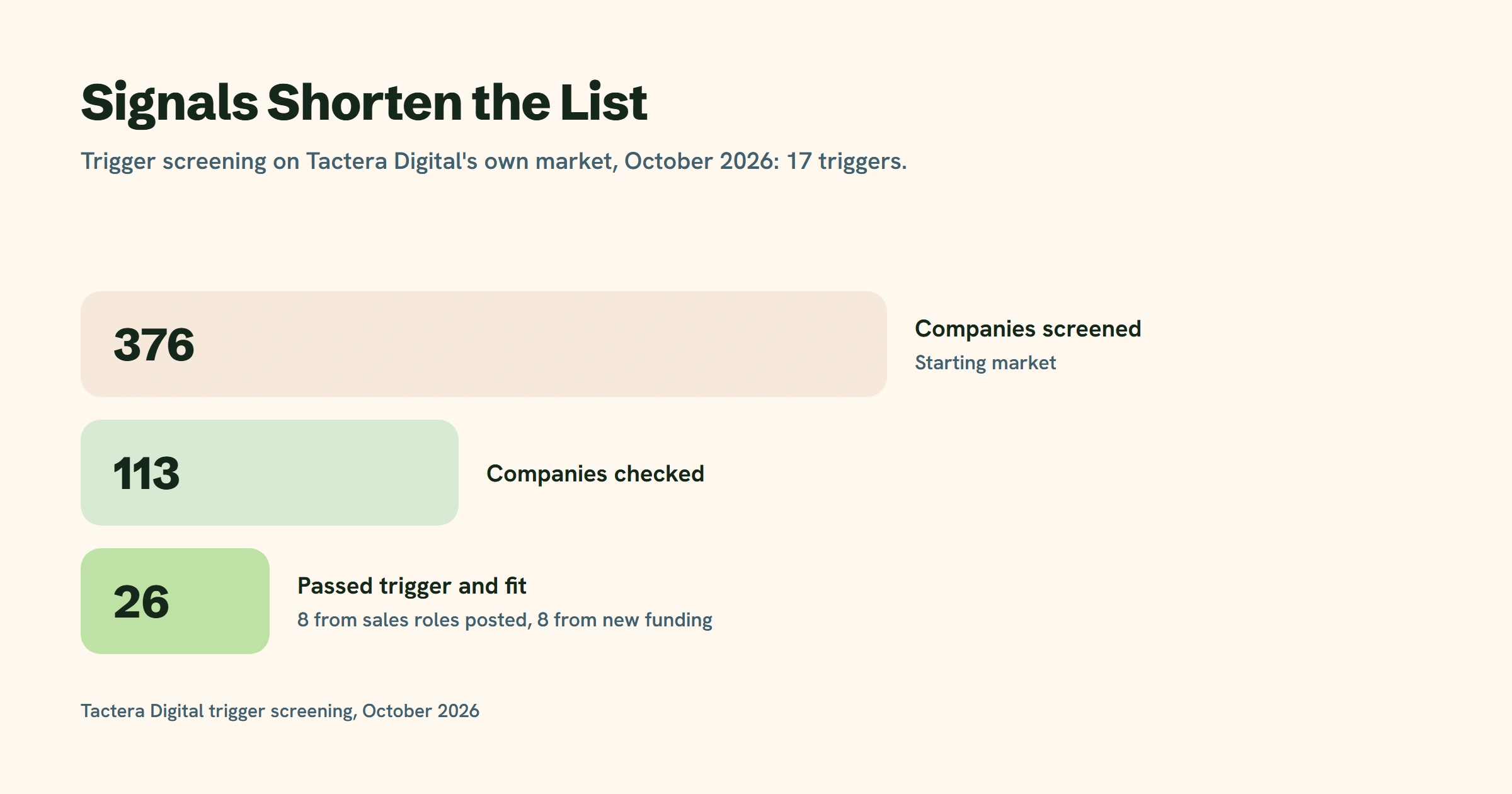
If signal-based selling increases the number of companies contacted each week, it has turned into volume. If it decreases that number while raising the share of qualified sales conversations, it is working.
Common Problems with Signal-Based Selling
5 problems can stop signal-based selling from producing pipeline. Each one has a fix:
- Alert overload. Signal feeds fill the queue faster than anyone can verify it. Fix: cap the list at 5 to 10 signals and audit each signal source against the companies you actually closed.
- Everyone sees the same signal. A public funding announcement is visible to every competitor. Fix: win on relevance as well as speed, with a message that ties the event to a specific problem your offer solves.
- Signals ahead of fit. A strong, recent signal at a company outside your market gets worked anyway. Fix: attach signals only to companies that already pass the fit check in the CRM.
- No owner between detection and outreach. Verified signals sit in a dashboard while every team assumes another one will act. Fix: name one owner per signal and set a response time; my team works to 24 hours from verification.
- Automated messages that recite the signal. A first line that lists what the sender found about the company reads as surveillance, not relevance. Fix: mention the change only where it explains why your offer matters now, and never list the research behind it.
How to Start Signal-Based Selling in 30 Days
The fastest reliable way to start signal-based selling is to run it on one market lane for 30 days before expanding. A small, measurable test beats a company-wide rollout that nobody can evaluate.
- Days 1 to 5: write the fit criteria and exclusions for one lane, and pick 5 signals that came before your best customers bought.
- Days 6 to 10: map each signal to a public source, set up the signal object with event and detection dates, and agree on who verifies and who acts.
- Days 11 to 25: verify signals daily, contact first-priority companies within 24 hours of verification and reach 3 to 5 people in each buying group.
- Days 26 to 30: review which signals produced replies and qualified sales calls, drop the weakest and decide whether to expand to a second lane.
Signal-Based Selling Is a Timing Discipline
Signal based selling is a timing discipline built on top of good targeting. Fit decides who belongs in your market, verified signals decide who hears from you first, and the measure of success is qualified sales calls rather than messages sent. Keep those 3 rules in that order and the method shortens the list while raising the quality of the conversations on it. Let signals replace fit and the result looks like a bigger list.
If you want a team that already runs this loop across LinkedIn, email and cold calling, See If We’re a Fit. No phone number required. No sales spam.
Sources
Tactera Digital data
- Tactera Digital trigger-screening run on its own market, October 2026: 376 companies screened against 17 triggers, 113 checked, 26 passed the trigger and fit checks.
- Tactera Digital outreach rules: first contact within 24 hours of a verified trigger, 3 to 5 people per buying group, Tactera Digital methodology, 2026.
External sources
- LinkedIn B2B Institute, The 95-5 Rule
- 6sense, 2026 B2B Buyer Experience Report
- Gartner, Sales Survey Finds 61% of B2B Buyers Prefer a Rep-Free Buying Experience, June 2025
Frequently Asked Questions
What Is Signal-Based Selling in Simple Terms?
Signal-based selling means contacting companies when something has just changed that gives them a reason to buy. The team watches for events such as a new executive, new funding or a hiring push at companies that fit its market, verifies each event, and contacts the affected decision-makers while the change is recent.
Is Signal-Based Selling the Same as Intent Data?
Signal-based selling is a method; intent data is one possible input. Intent data usually means third-party research activity sold by data vendors. Signal-based selling can run on public company events, first-party engagement, conversational cues or intent data. I rely on public events because each one carries a date and a source that can be checked.
Who Owns Signal-Based Selling in a Sales Team?
The sales leader owns signal-based selling as a whole: the fit criteria, the signal list and the monthly review. RevOps usually owns the data side, meaning detection, verification, routing and reporting. SDRs or sales reps own first contact with the buying group. Each verified signal needs one named owner and an agreed response time.
How Many Signals Should a Team Track?
Start with 5 to 10 signals for one market. Choose events that happened at your best customers in the months before they bought. A short list can be verified daily and measured; a long list floods the team with alerts and hides which signals actually produce qualified sales calls.
Does Signal-Based Selling Replace Cold Outreach?
Signal-based selling changes the order and timing of outreach rather than replacing it. First contacts still go out by email, LinkedIn and phone. The difference is that each contact is aimed at a company with a current, verified reason to talk, and the message refers to that reason.
Does Signal-Based Selling Work for Small Teams?
Signal-based selling works well for small teams because it reduces the number of companies worth contacting each week. A single rep can run one market lane with 5 signals, a daily verification habit and a simple CRM record. The constraint is time for verification, not team size.