
Key Takeaways
- Buying signals set the order of outreach. Fit decides who qualifies.
- B2B buying signals come in 3 observable types: company-level, engagement and conversational.
- Tactera Digital treats signals up to 30 days old as first priority for email and calls.
- Verify the date, the company and the fit before any outreach.
Buying signals are the observable events and actions that show a company may be ready to buy what you sell. A new sales leader, a funding round, a plant expansion or a second visit to your pricing page all count. Read in time, they tell your team which companies to contact first and why.
Most guides on this topic list examples and stop there. This one goes further. It covers how to verify a signal before acting on it, how long each signal stays useful, which signals matter in which industry, and the one rule I hold to in every campaign: a signal decides who you contact first, but fit decides who qualifies.
What Are Buying Signals in Sales?
Quick Answer: Buying signals are events or actions that suggest a company is moving toward a purchase. In B2B they fall into 3 groups: company-level events such as leadership changes, funding or expansion; engagement on your own website and emails; and statements buyers make in sales conversations. Signals set outreach timing, not qualification.
A buying signal does not prove intent to buy. It raises the odds that the timing is right, which is why signals decide the order of outreach while fit decides who qualifies.
2 terms make the idea precise. An in-market company is a company already showing signs it is looking to buy what you sell. A buying window is the period when an in-market company is actively evaluating and able to buy. Buying signals are how you spot in-market companies and estimate when their buying window opens.
Company-Level and Person-Level Signals
B2B buying signals work at 2 levels. Company-level signals describe the organization: it raised money, opened a site, hired a new chief information security officer or filed a permit. Person-level signals describe one buyer: they downloaded a guide, asked about pricing or changed jobs.
The distinction matters because B2B purchases are group decisions. A single person’s click tells you less than a company event that affects the whole buying group. The buying group is the people who decide a purchase together: budget holder, decision-maker, project lead and day-to-day user.
Buying Signals in B2B vs B2C
B2B buying signals and retail buying signals look alike on the surface but work differently. In B2C, one person often researches and buys in a single session, so behavior on the site carries most of the weight. In B2B, the buying cycle runs for months, several people take part, and many of the strongest signals happen outside your website entirely. That is why company-level events dominate B2B signal programs and why this guide spends most of its time on them.
Buying Signals in Sales vs Marketing
Sales and marketing teams read the same buying signals for different jobs. Marketing uses them to decide where to spend attention: which companies to show ads to, which industries to write for and which audiences to retarget. Sales uses them to decide whom to contact this week and what to say. The signal is the same; the action and the time frame are not.
Buying signal marketing strategies tend to work on groups of companies at once. A marketing team might build an audience of every company in its market that announced an expansion this quarter and warm it with ads before outreach starts. A sales team works one company at a time and needs the detail: the date of the expansion, the site, the person who owns the project. Both work best when marketing warms the companies that sales is about to contact, not a separate list.
Why Buying Signals Matter for Qualified Sales Pipeline
Buying signals matter for qualified sales pipeline because most of a B2B purchase is decided before a seller is invited in. Contacting a company inside its buying window puts your team in front of the buying group while preferences are still forming. Contacting it outside the window adds a name to a list and little else.
The research on buyer behavior makes the timing problem concrete. The 6sense 2026 B2B Buyer Experience Report found that buying groups average 10 members, that the buyer’s team initiated 82% of first vendor contacts, and that first live contact with a seller still landed past the midpoint of the buying journey. The same report found that in 71% of journeys the group entered with preferences for 2 or more vendors already held by its members.
2 practical conclusions follow from that research:
- Waiting to be contacted means arriving late. If buyers start most first contacts themselves and do it past the midpoint, a vendor that only responds to inbound interest meets the group after the shortlist exists.
- Identity is hidden for most of the journey. The 2026 report found that just 35.2% of buyers used their own contact information on a form. Signals that depend on a named person filling in a form miss most of the activity.
Company-level buying signals fill that gap. A leadership change, a funding round or an expansion is public, dated and tied to a named company, whether or not anyone from that company has visited your site.
This is also the logic behind signal-based selling: instead of working a static list in alphabetical order, the team works the companies with live reasons to buy first. The approach does not replace qualification. It changes the order of the queue.
Types of B2B Buying Signals
B2B buying signals fall into 3 types that a sales team can observe and act on: company-level signals, engagement signals on your own channels, and conversational signals in sales calls. A 4th source, third-party research activity across the web, is sold by data vendors as intent data. The table below compares these 3 types of observable signals.
| Type | Examples | Where You Observe It | What It Tells You |
|---|---|---|---|
| Company-level signals | Leadership change, funding round, hiring surge, expansion, tender, technology change | Press releases, filings, job boards, public procurement portals, permits | A company has a new reason, budget or deadline that can open a buying window |
| Engagement signals | Pricing page visits, demo requests, guide downloads, replies to outreach | Your website analytics, CRM, email and LinkedIn | A known person is researching your category or your company |
| Conversational signals | Questions about price, implementation, security or next steps; new stakeholders joining | Discovery calls, demos, email threads | A buying group is evaluating you specifically |
Third-party research activity, such as reading about a topic across publisher networks, is a separate data type with its own strengths and limits. What intent data is, and where it falls short, is covered in its own guide. This guide stays with signals your team can observe and verify directly.
Company-Level Signals
Company-level signals are public events that change what a company needs, can afford or must do by a deadline. These are the backbone of outbound prospecting because they are visible before anyone at the company talks to you. The 6 that matter most across B2B markets:
- Leadership change. A new executive in the role that owns your category often reviews existing vendors and processes. A new chief revenue officer, chief information security officer or head of operations is often the clearest leadership change signal.
- Funding round. New capital comes with a plan to spend it. A funding round signals budget and a mandate to grow, though the spending plan may not include your category.
- Hiring surge. A cluster of job postings in the team you serve shows where the company is investing. 10 open roles for sales reps say more about sales priorities than a press release does.
- Expansion. A new office, plant, distribution center or market entry creates new requirements for space, systems, suppliers and people.
- Tenders and requests for proposal. Public procurement notices state the need, the deadline and often the budget range in writing. They are the most explicit company-level signal and also the most competitive.
- Technology change. A migration, a new platform or the end of a contract with an incumbent vendor opens a decision that was closed before.
Each of these is a trigger event: a dated change that creates a reason to act. Some trigger events produce longer and more reliable buying windows than others. The ranking of individual triggers, and how long each one stays open, is covered in the guide to sales trigger events.
Engagement Signals on Your Own Channels
Engagement signals are actions people take on channels you control: your website, your emails, your LinkedIn posts and your outreach. They are first-party data, which makes them accurate about what happened but limited in reach. You only see the companies that already found you.
The engagement signals with the most weight are the ones close to a decision: repeat visits to pricing or comparison pages, a demo request, a reply asking a question, or several people from the same company engaging in the same week. Low-weight engagement includes a single blog visit, a newsletter open or a social media like. Those show awareness, not buying intent.
Conversational Signals in Sales Calls
Conversational signals are the things buyers say, ask and do once a conversation has started. They are the oldest form of buying signal and still the most direct. A buyer who asks how long implementation takes is already picturing the project. A buyer who brings a finance colleague to the second call is moving the decision forward.
Verbal buying signals include questions about price, contract terms, integrations, security reviews, timelines and references. Behavioral cues in a conversation include adding stakeholders, sharing internal documents, asking for a proposal and agreeing to a next meeting. Objections can be buying signals too: a detailed objection about cost or risk means the buyer is evaluating, not ignoring you.
25 Buying Signals Examples for B2B Sales
The list below gives 25 examples of buying signals across the 3 types, with where each one can be observed. Use it as a working list of B2B buying signals to monitor, then narrow it to the signals that match your market and offer. Each example is rated Strong, Medium or Weak using the test in the section on strong vs weak buying signals below: is the signal specific, dated and tied to a decision your offer supports?
Company-Level Examples
- A new executive in the role that buys your category. Observe on LinkedIn, press releases and, for US public companies, Form 8-K filings, which disclose officer appointments and departures. Strength: Strong.
- A sales or marketing leader leaves. A departure often precedes a review of the team, the tools and the agencies the previous leader chose. Strength: Medium.
- A funding round closes. Observe in funding announcements and, for US private offerings, Form D notices filed with the SEC. Strength: Medium.
- A merger or acquisition is announced. Integration forces decisions on systems, suppliers and teams. Strength: Medium.
- A cluster of job postings in the team you serve. Several open roles in one function in the same month signal investment in that function. Strength: Strong.
- Roles posted again after 60 days. A role that keeps reappearing can mean the company is struggling to fill it, which creates demand for outside help. Strength: Medium.
- A new office, plant or distribution center. Observe in press releases, local news and economic development announcements. Strength: Medium.
- Entry into a new country or region. New markets need local suppliers, compliance work and pipeline. Strength: Medium.
- A public tender or request for proposal. Observe on procurement portals such as SAM.gov in the US and Find a Tender in the UK. Strength: Strong.
- A building permit or rezoning filing. Observe in city and county permit records; it signals construction, fit-out and equipment purchases months ahead. Strength: Strong.
- A new regulation with a compliance deadline. The deadline sets the buying window for every affected company. Strength: Strong.
- A technology migration. A move to a new CRM, ERP or cloud platform reopens decisions about connected tools and services. Strength: Strong.
- A contract with an incumbent vendor nearing its end. Observe in public contract records or ask directly in conversation. Strength: Strong.
- A product launch. Launches create short-term needs for marketing, sales capacity and support. Strength: Weak.
- A major contract win. New revenue often comes with delivery requirements the company cannot meet with current resources. Strength: Medium.
Engagement Examples
- Repeat visits to your pricing page. 2 or more visits in a week from the same company suggest active evaluation. Strength: Strong.
- A demo or consultation request. The most explicit first-party signal. Strength: Strong.
- A download of a bottom-of-funnel asset, such as a pricing guide, a comparison or a case study. Strength: Medium.
- Several people from one company engaging in the same week. A sign that a buying group, not one curious person, is researching. Strength: Strong.
- A reply to outreach that asks a question. Any reply with a question about scope, price or timing is a buying signal, even if the tone is cautious. Strength: Strong.
- A former customer or champion starts at a new company. People who bought from you once tend to bring trusted vendors into their new role. Strength: Medium.
Conversational Examples
- Questions about price, contract terms or payment schedule. Strength: Strong.
- Questions about implementation time, integrations or security review. Strength: Strong.
- A new stakeholder joins the next call, especially someone from finance, procurement or IT. Strength: Strong.
- A request for a proposal, references or a next meeting date. Strength: Strong.
Not every example is equally strong. A request for proposal or a pricing conversation means more than a single social media like. The next sections cover how to tell which signals are reliable and how long they stay useful.
How to Identify Buying Signals
Quick Answer: To identify buying signals, first define which company events and actions predict a need for your offer. Then monitor the public sources where those events appear, such as filings, job boards, procurement portals and news, alongside your own website and CRM. Verify each signal’s date and company match before acting on it.
Teams that skip the first step drown in alerts. Teams that skip the last step contact companies about events that never happened or ended months ago.
The steps below apply whether a person checks the sources by hand or a monitoring system does it.
- Define your ideal customer profile first. A signal at a company you cannot serve is noise. Fit comes first, signals second.
- Choose 5 to 10 signals that predict a need for your offer. Ask which events, in your best customers’ history, came shortly before they bought from you.
- Map each signal to its source. Every signal needs a place where it can be observed reliably and dated.
- Monitor continuously. Buying signals lose value with age, so a monthly check misses most of the window.
- Verify before acting. Confirm the date, the company and the fact itself.
- Record the signal with the outreach. Log the signal type, date and source against the company, so you can see later which signals turned into sales conversations.
Researching the company behind the signal is its own skill. The guide on how to research companies for sales outreach covers it in depth.
How to Identify Online Buying Signals
To identify online buying signals, combine 2 views: your own channels and the public web, where filings, job boards, news and social networks publish company events. The first view is your own channels, where website analytics, form fills and email replies show which known companies are engaging. The second view is the public web, where company events are published whether or not the company has heard of you.
Most teams start with the first view because the data is already in their tools. The second view is where most of the volume is. A company that has never visited your site can still announce a new chief operating officer, a plant expansion and 12 open roles in the team you serve in the same quarter. Software that detects buying signals can automate parts of this work; what each type of buying signals software actually detects is a separate comparison. Teams targeting by installed technology can also start from technographic data platforms, which show what software a company runs.
Public Sources That Show Real-Time Buying Signals
Real-time buying signals are signals detected within hours or days of the event, while the window is still open. Public sources are the most reliable way to catch them, because the source itself carries the date.
| Source | Signals It Shows | Notes |
|---|---|---|
| Company press releases and newsrooms | Leadership changes, funding, expansion, contract wins, launches | Dated and attributable; check the company’s own site |
| Regulatory filings | Officer changes (Form 8-K), private funding (Form D), product clearances | US filings are public on SEC and agency databases |
| Job boards and careers pages | Hiring surges, new functions, reposted roles | Check the posting date; reposts can look new |
| Public procurement portals | Tenders and requests for proposal | SAM.gov (US), Find a Tender (UK); deadlines are stated |
| Permit and planning records | Construction, fit-outs, new sites | Local government portals; filings come months before work |
| Job changes, new hires, company announcements | Confirm the start date on the profile, not the post date | |
| Your own website, CRM and inbox | Pricing visits, demo requests, replies | Accurate but limited to companies that already found you |
I use only public signals for my own outreach and for client campaigns. Public signals carry a date and a source, so they can be checked within hours. Signals bought from third-party platforms usually arrive with a delay. A sales leader at a staffing company told me their team uses a well-known intent data platform and finds it only 10% to 20% accurate. That is one team’s experience, not a benchmark, but it matches why I verify every signal at the source.
Verify the Signal Before You Act
Verifying a buying signal means confirming 3 facts before any outreach: the event happened, it happened at this company, and it happened recently enough to matter. Skipping verification is the most common way signal programs damage trust, because a message about a stale or wrong event tells the buyer you did not look.
Check each signal against these points:
- Date. Confirm when the event happened, not when an article or database recorded it. A funding round reported this week may have closed 4 months ago.
- Company match. Confirm the legal entity, the location and the parent company. Similar names and subsidiaries cause most mismatches.
- Reposted job ads. A role that has been open for months can reappear as a new posting. Check whether it is a new need or the same one.
- Role relevance. A new executive matters only if the role owns the decision for your category.
- Fit. Confirm the company still matches your ideal customer profile. Signals never override fit.
Signal Reliability and Signal Decay
Signal reliability is how strongly a buying signal predicts a real buying window. Signal decay is the loss of that predictive value over time. Both decide which companies go to the top of the outreach queue and which channels to use.
Strong vs Weak Buying Signals
Strong buying signals are specific, dated and tied to a decision your offer supports. A tender for your exact service, a new executive who owns your category, or a pricing conversation on a live call are strong. Weak buying signals are generic or ambiguous: a single page view, a social media like, or industry news that affects every company equally.
Stacked signals are stronger than single ones. A company that raised money, hired a new head of sales and posted 6 sales roles in the same quarter shows a clearer buying window than a company with any one of those events. When I ran our trigger-screening agents on our own market in October 2026, they screened 376 companies against 17 triggers, and 26 passed both the trigger check and the fit check. 8 of the 26 passes came from sales roles posted and 8 from new funding; 7 of the 17 triggers produced no passes at all.
How Long Buying Signals Stay Useful
Buying signals decay because the window they point to closes. A new executive settles into the role and sets its priorities. A funding round gets allocated. A tender has a deadline. The longer a team waits, the more likely the decision has already been made or a competitor has already been invited.
I work signals in age bands, and the band decides both the priority and the channels.
| Signal Age | Priority | Channels |
|---|---|---|
| Up to 14 days | First priority | Email and calls |
| Up to 30 days | First priority | Email and calls |
| Up to 60 days | Second priority | Email and calls |
| Up to 90 days | Second priority | Email and calls |
| Older than 90 days | Third priority | Email only |
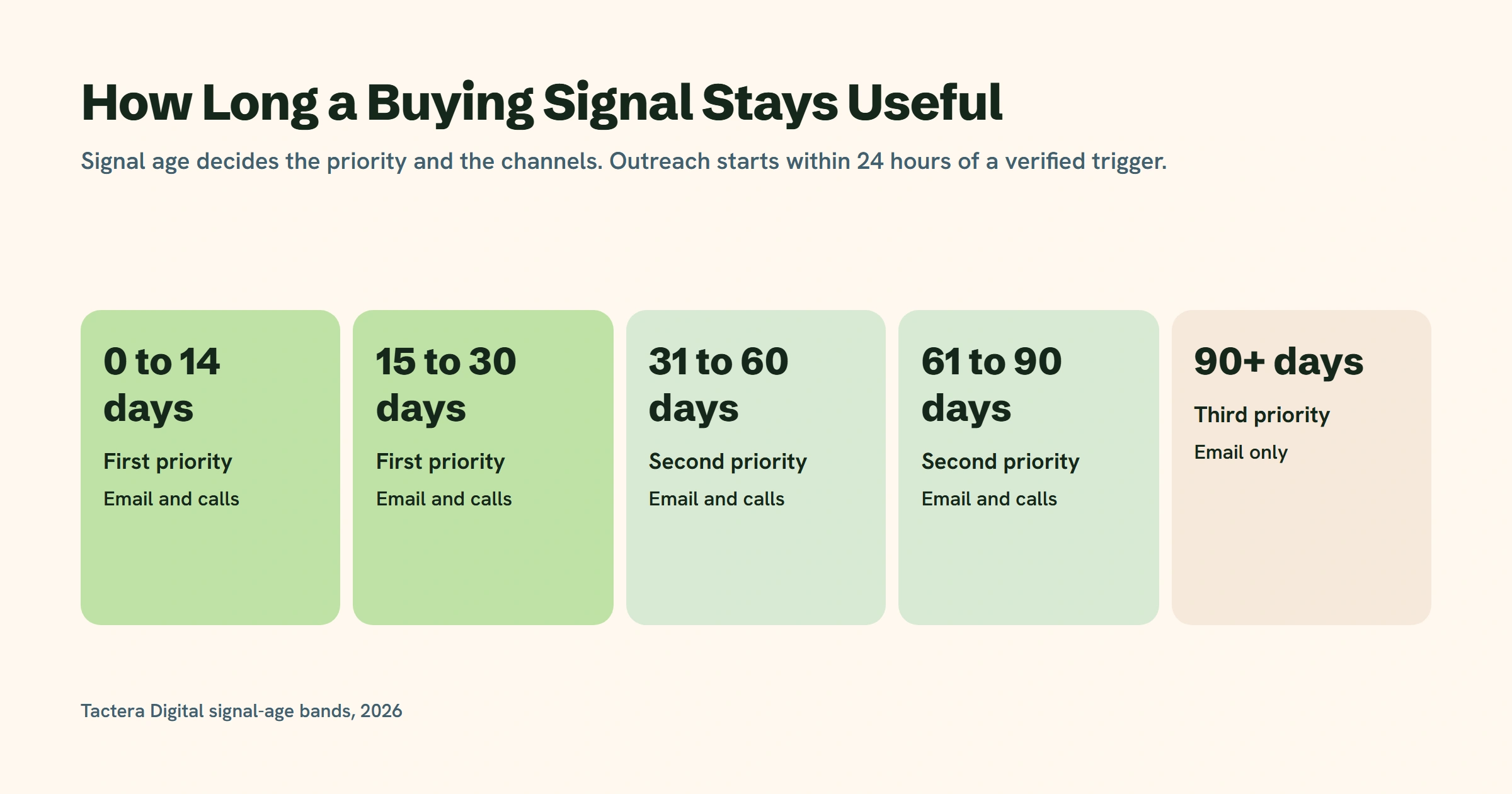
Outreach timing matters inside each band as well. My team contacts a company within 24 hours of a verified trigger. The fastest outreach is not always the best, but outreach that arrives weeks late is rarely relevant to the reason the company was selected.
Buying Signals by Industry
Buying signals are industry-dependent: the events that open a buying window for a commercial HVAC contractor’s customers are not the ones that matter to a fintech vendor’s buyers. The table below lists signals I track across 10 industries Tactera Digital serves. Industries with their own guide link to it for the full breakdown.
| Industry | Signals Tracked | More |
|---|---|---|
| Cybersecurity | New security leader, new compliance deadline, new funding round | Cybersecurity buying signals |
| GRC and AI governance | New rule or enforcement date, AI rollout, regulator action or audit finding | GRC buying signals |
| SaaS | New leader in the buying team, new funding, tool migration | SaaS buying signals |
| Logistics | New distribution center or plant, new supply chain leader, carrier or 3PL contract up for renewal | Logistics buying signals |
| Commercial HVAC | New building or tenant fit-out, new facility manager, energy code deadline, aging equipment, refrigerant rule changes | HVAC lead generation |
| Managed IT (MSPs) | New IT or operations leader, office move or new location, new compliance requirement, IT contract nearing its end, fast hiring | Lead generation for MSPs |
| Fintech | New funding round, new compliance rule, core or ERP system migration, new CFO or finance leader, expansion into a new market | Fintech lead generation |
| Healthcare | New funding round, new FDA milestone, new compliance deadline, new CEO, CFO or COO, merger or acquisition | Healthcare lead generation |
| Manufacturing | Plant expansion or new facility, new contract win, new operations or procurement leader, reshoring announcement, supplier contract up for renewal | Lead generation for manufacturers |
| Construction | Land purchase or rezoning, building permit filed, project financing closed, expansion announced, new facilities or construction leader | Construction lead generation |
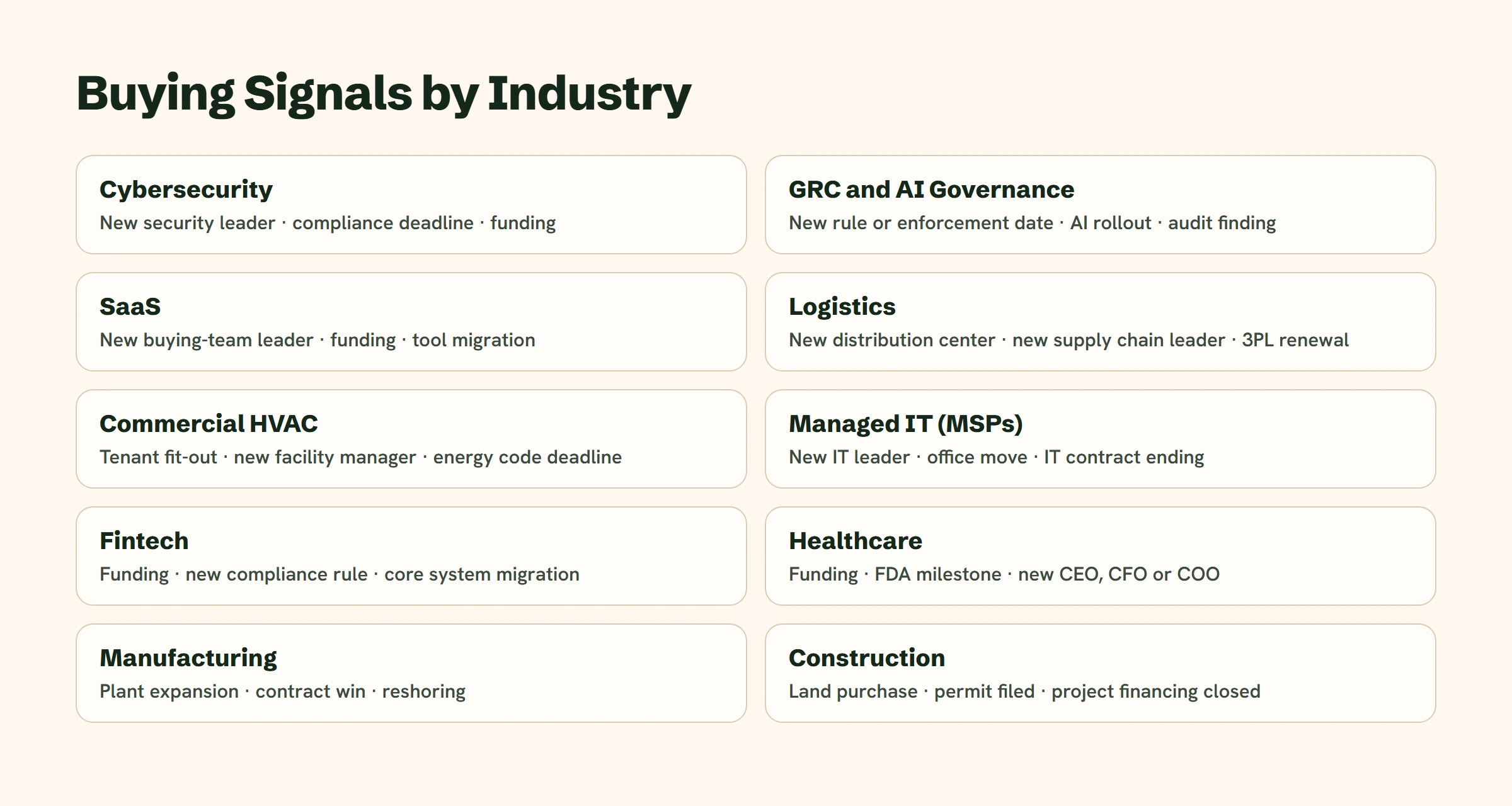
2 patterns stand out across the table. Leadership changes and funding appear in most industries, which makes them good default signals for a new campaign. The most predictive signals, though, are industry-specific: a permit filing, a refrigerant rule or a carrier contract renewal says more about a buying window in its own market than any general signal does.
How to Act on Buying Signals Without Losing the Qualification
Acting on buying signals means using them to set the order and timing of outreach while fit decides who qualifies. A signal answers “why now”. Your ideal customer profile answers “why this company”. A program that lets signals replace fit fills calendars with companies that have a reason to buy but not from you.
In practice, acting on a signal comes down to 3 decisions:
- Qualify on fit first. Industry, size, geography and the problem you solve decide whether a company belongs on the list at all.
- Order by signal strength and age. Companies with strong, recent and stacked signals go to the top of the queue; companies with weak or old signals move down or wait.
- Reach the buying group, not one person. A signal at company level affects several roles. Mapping the B2B buying committee shows who the budget holder, decision-maker, project lead and day-to-day user are.
How to word the first message after a signal is covered in the guide on how to respond to buying signals. Signal-led outreach also changes how cold a first contact feels; warm outbound vs cold outbound compares both approaches. Teams deciding between a named-company strategy and a broader lead program can weigh account-based marketing vs lead generation.
Tactera Digital builds outbound programs on this rule. It monitors public buying signals for each client’s market through its Commercial Intent Monitor, qualifies every company on fit before any signal is considered, contacts decision-makers within 24 hours of a verified trigger, and books qualified sales calls directly into the client’s calendar. Tactera Digital reports $110M+ in sales pipeline generated for clients in 2 years, $50M+ in closed revenue for clients in 2 years and 4,000+ commercial opportunities generated in 2 years, with the pipeline and revenue figures reported by clients.
A Worked Example of Signal Ordering
The example below shows how the rules above order a week of outreach. The companies are illustrative, not clients.
| Company (Illustrative) | Fit with Your Offer | Signals | Signal Age | Decision |
|---|---|---|---|---|
| Company A, 300 staff | Yes | New funding round, new head of sales | 10 days | First priority: email and calls this week, reach the full buying group |
| Company B, 120 staff | Yes | 6 open roles in the team you serve | 25 days | First priority: email and calls |
| Company C, 800 staff | Yes | New operations leader | 75 days | Second priority: email and calls after the first-priority list |
| Company D, 200 staff | Yes | Expansion announced | 5 months | Third priority: email only |
| Company E, 40 staff | No: below your size floor | New funding round | 7 days | Excluded: the signal does not override fit |
Company E is the case most programs get wrong. The funding round is real and recent, so the signal looks strong. But a company outside your fit criteria will not become a qualified sales conversation because it raised money. The signal earns a place in the queue only after fit says yes.
Signal-based outbound is outreach aimed at in-market companies during their live buying windows, not at a static list. For teams that want to test it on their own market first, the Pilot Program is free to start. It runs for 30 days on one service lane, by email. It generates 3 Qualified Commercial Opportunities™ (QCOs), then switches to scale with the Topline Revenue Growth Program™.
Common Mistakes with Buying Signals
These are the most common ways a buying signal program fails.
- Treating every signal as equal. A social media like and a public tender go into the same alert feed. Without a ranking by strength and age, the team works the loudest alerts instead of the best companies.
- Letting signals override fit. A company with a strong signal and no fit wastes the same time as a company with no signal. Fit first, then signals.
- Acting on stale signals. A message about a funding round from 6 months ago tells the buyer you are reading an old database, not following their company.
- Contacting one person. Company-level signals affect a buying group of about 10 people, according to the 6sense 2026 research cited above. Writing only to the most senior title misses the project lead and the day-to-day user who often shape the decision.
- Measuring alerts instead of conversations. The number of signals detected says nothing about pipeline. The measure that matters is how many signals turn into qualified sales conversations.
How to Measure a Buying Signal Program
A buying signal program is measured by how many verified signals turn into qualified sales conversations, and how fast. Counting alerts or opens measures activity, not results.
Track these 5 numbers for every signal type you use:
- Verified signals. How many detected signals passed the date, company and fit checks. A low pass rate means the source or the signal definition needs work.
- Time from signal to first touch. Hours or days between the event and the first outreach. This is the number that decay punishes most.
- Signal to conversation rate. The share of verified signals that turned into a reply and then a sales conversation.
- Qualified sales calls by signal type. Which signals produce conversations with decision-makers at companies that fit. This is where a signal earns its place on the list.
- Signals dropped. Signals that produced no qualified conversations after a fair test should be removed. A short list of signals that work beats a long list that floods the team.
To get these numbers, record the same fields for every signal in your CRM:
- signal type and the event it describes;
- event date and the date your team detected it;
- source, with the link;
- date the signal was verified, and who verified it;
- age band at first touch;
- time from detection to first touch;
- outcome: no reply, reply, sales conversation or qualified sales call.
Review the numbers monthly and change one thing at a time: a signal, a source or the age band. Over a few months the list narrows to the signals that predict buying windows in your market, which is the real asset a signal program builds.
Turning Buying Signals into Pipeline
Buying signals turn into pipeline when they are verified, worked while fresh and used to order outreach rather than to qualify it. The companies worth contacting this week are the ones that fit your market and just went through a change that gives them a reason to act.
Start small. Pick the 5 signals that came before your best customers bought, map them to public sources, verify each one before outreach and work the first 30 days hardest. Then measure which signals turned into sales conversations and drop the ones that did not.
If you want a team that already runs this process across LinkedIn, email and cold calling, See If We’re a Fit. No phone number required. No sales spam.
Sources
Tactera Digital data
- Tactera Digital trigger-screening run on its own market, October 2026: 376 companies screened against 17 triggers, 26 passed the trigger and fit checks.
- Tactera Digital signal-age bands and 24-hour outreach rule, Tactera Digital methodology, 2026.
- Signals Tactera Digital tracks in 10 industries, Tactera Digital industry pages, 2026.
External sources
- 6sense, 2026 B2B Buyer Experience Report
- Investor.gov (SEC), Form 8-K and Form D
- SAM.gov (US) and Find a Tender (UK), public procurement portals
Frequently Asked Questions
What Is an Example of a Buying Signal?
A new executive taking over the role that buys your category is a strong example of a buying signal. New leaders often review vendors, tools and processes, which can open a decision that was closed before. Other common examples are a funding round, a hiring surge, an expansion, a public tender and repeated visits to your pricing page.
What Are Customers’ Buying Signals?
Customers’ buying signals are the actions and statements that show a buyer is moving toward a purchase. In B2B they include company events such as leadership changes, funding and expansion; engagement on your channels such as pricing page visits and demo requests; and conversational cues such as questions about price, implementation or contract terms, or a new stakeholder joining the next call.
What Is the Strongest Buying Signal in B2B?
The strongest buying signal in B2B is an explicit, dated statement of need: a public tender, a request for proposal or a buyer asking for pricing and contract terms. Among signals you can observe before any conversation, several stacked events in one quarter, such as new funding, a new executive and a hiring surge, predict a buying window better than any single event.
How Long Does a Buying Signal Stay Relevant?
Tactera Digital treats a buying signal as most useful in its first 30 days: signals up to 30 days old are first priority for email and calls, signals up to 90 days old are second priority, and anything older than 90 days goes to email only. Tenders and compliance deadlines carry their own stated dates.
Are Objections Buying Signals?
Specific objections are often buying signals. A buyer who raises a detailed concern about cost, risk, integration or timing is evaluating your offer instead of ignoring it. The useful distinction is between an objection about how the purchase would work, which shows engagement, and a refusal to discuss the topic at all, which shows the buyer is not in market.
What Are Real-Time Buying Signals?
Real-time buying signals are signals detected within hours or days of the event, while the buying window is still open. Examples are a leadership announcement, a funding close, a new job posting or a pricing page visit. Real-time detection matters because buying signals decay: a team that learns about an event weeks later often arrives after the decision.
Does a Buying Signal Mean a Company Will Buy?
A buying signal does not mean a company will buy. It means the company has a reason, budget or deadline that makes a purchase more likely now than before. Whether the company buys from you depends on fit, on reaching the right people in the buying group and on the quality of your offer. Signals set the timing; qualification still decides.